Clearing UGC NET is not just an achievement but the starting point for a career in academia. It strengthens a résumé and offers the kind of recognition that scholars of English literature seek. Another advantage is that the UGC NET qualification has lifetime validity, which means it can be used to apply for various PSC Assistant Professor examinations across states.
However, in recent years the syllabus has expanded considerably. It now includes many areas that go beyond the traditional boundaries of conventional English literature syllabi, which can make the topics ambiguous and the pattern difficult to navigate. The vast syllabus can feel overwhelming even for strong postgraduate students and subject experts.
Still, the exam is definitely manageable with the right approach. Instead of trying to cover everything randomly, it helps to understand the question pattern carefully and prepare in a strategic way. Preparation should not only focus on studying content but also on learning how the exam works.
This blog series aims to break down practical ways to prepare for the UGC NET effectively. In this first piece, we will focus on understanding the latest pattern of the UGC NET English Literature examination and how to approach the plethora of topics. The next blog will come with a clear and focused strategy along with sources of studying for the same.
Let us look at the topic-wise breakdown of PYQ papers, and then move on to a detailed paper pattern analysis.
British History: The Backbone
British Literature and History of English Literature are the ironclad backbone for UGC NET domination. The core British Literature questions, though, are being re-wired by the examiners to test in-depth and analytical comprehension of subject. Classics like Chaucer, Shakespeare, University Wits, Romantics, and Victorians continue to remain non-negotiables. The game-changer is the approach to them — examiners are ditching outdated methods to test us upon them. Here is a detailed explanation:
Take Chaucer for example. The question below makes it evident that we are expected to delve deep into all Chaucerian texts. Just prima facie knowledge of the Prologue to the Canterbury Tales is not enough to crack NET. It is imperative that all his texts are studied with precision and patience.
PYQ — Which of the following statements about Geoffrey Chaucer are correct?
- Chaucer’s first work, The Book of the Duchess, is a dream-poem on the death in 1368 of Blanche, Duchess of Lancaster, the wife of John of Gaunt.
- In The House of Fame, it is the first time that Dante’s epic of a journey to Paradise, Purgatory, and Hell — The Divine Comedy — is echoed in English.
- The Canterbury Tales absorbs literary, historical, religious, social, and moral concerns, and transcends them all.
- In The Legend of Good Women, Cupid and Venus, passion and desire, innocence and knowledge, are all invoked.
- The Miller’s Tale is an old-fashioned fable, a story of deception in war, almost similar to The Knight’s Tale.
Similarly, Shakespeare’s lines and dialogues of important characters are quintessential:
Q.83 — The following lines are spoken by which character in Shakespeare’s plays?
Put out the light and then put out the light;
If I quench thee, thou flaming Minister,
I can again thy former light restore—
- King Lear
- Hamlet
- Othello
- Macbeth
A question such as the one below is rather innovative and requires us to re-orient how we approach the canonicals. It is suggestive of the fact that we must study re-workings and re-interpretations of all classical texts — not just Shakespeare. Question after is also on the similar lines.
PYQ — Match List-I with List-II:
| List I | List II |
|---|---|
| A) Come what come may, Time and the hour runs through the roughest day. | I. Othello |
| B) When sorrows come, they come not single spies. But in battalions! | II. King Lear |
| C) I am a man more sinned against than sinning. | III. Macbeth |
| D) But I will wear my heart upon my sleeve For daws to peck at: I am not what I am. | IV. Hamlet |
Q.40 — Which of the following plays of William Shakespeare was translated into Bengali and directed by Girish Chandra Ghosh?
- The Tempest
- Hamlet
- Macbeth
- King Lear
Q.90 — Which two plays of Anton Chekhov made creative use of Shakespeare’s Hamlet?
- A Marriage Proposal
- Three Sisters
- The Cherry Orchard
- Uncle Vanya
- The Seagull
Talking of the classics, John Webster’s Duchess of Malfi has been a recent favourite of the examiners. A probable reason is that it is gaining critical importance in the postmodern, post-truth world. Theatre artists and filmmakers have been reworking it, making academic engagement more pertinent.
PYQ — Which of the following details about the Dramatis Personae of The Duchess of Malfi are correct?
- FERDINAND [Duke of Calabria].
- CARDINAL [Executioner].
- ANTONIO [BOLOGNA, Steward of the Household to the Duchess].
- DELIO [Court Officer].
- DANIEL DE BOSOLA [Gentleman of the Horse to the Duchess].
Coming further down the historical age into the Restoration Theatre, there is always a question from Congreve or Wycherley or Etherege, making them must-read dramatists along with their socio-political significance.
PYQ — Which of the following descriptions of characters from William Congreve’s The Way of the World is incorrect?
- Fainall, in love with Mrs. Marwood
- Mirabell, in love with Mrs. Millamant
- Witwoud, follower of Mrs. Millamant
- Petulant, follower of Mrs. Marwood
A rudimentary question from Dickens — however basic only if we have read his major novels. Fictional Victorian novelists to go over would be described in detail in the coming blog.
PYQ — In which of the following novels of Charles Dickens is the city of London shown shrouded in fog in the opening chapter?
- Bleak House
- A Tale of Two Cities
- Oliver Twist
- David Copperfield
All in all, in the last UGC NET examination there were 2 questions from Shaw, 2 from Bacon and 1 each from Hardy and Orwell — cementing their significance. Along with these, postmodern canons such as Beckett and Pinter are non-negotiables as they hold great value in UGC NET and critical value within English academia. We shall learn in the next blog how to effectively study them, pertinently contextualising their work.
Chronology is Sacrosanct
Almost 8 questions were asked with respect to chronological arrangement in the Dec 2025 paper. And not just chronological arrangement of an author’s oeuvre — the examiners are coming up with rather innovative and twisty ways of situating chronological questions, such as the one listed below:
PYQ — Arrange the following events in chronological order related to George Bernard Shaw’s Arms and the Man:
- Arms and the Man was first performed at the Avenue Theatre.
- There was a release of a British film adaptation of Arms and the Man directed by Cecil Lewis.
- A German film adaptation was released, which garnered an Academy Award nomination for Best Foreign Language Film.
- Arms and the Man is a comedic play, set during the Serbo-Bulgarian War, which lasted fourteen days from 14 to 28 November.
- There was the famous London revival at The Old Vic starring Ralph Richardson and Laurence Olivier.
The following question would qualify for a classical must-read British author with historical significance — needing careful reading of all his major essays to solve these types of questions:
PYQ — Arrange the following statements in the order of their appearance in Bacon’s essay “Of Studies”:
- Their chief use for delight, is in privateness and retiring
- To spend too much time in studies, is sloth
- Crafty men contemn studies; simple men admire them; and wise men use them
- They perfect nature, and are perfected by experience
- Histories make men wise; poets, witty; the mathematics, subtle; natural philosophy, deep; moral, grave; logic and rhetoric, able to contend
PYQ — Arrange the following novels in chronological order of their publication:
- The Handmaid’s Tale
- Lucky Jim
- The Prime of Miss Jean Brodie
- Things Fall Apart
PYQ — Arrange the following works of criticism in chronological order:
- T. S. Eliot, The Use of Poetry and the Use of Criticism
- J.C. Smith, A Study of Wordsworth
- D. G. James, Scepticism and Poetry
- Marjorie L. Barstow, Wordsworth’s Theory of Poetic Diction
- Josephine Miles, Pathetic Fallacy in the Nineteenth Century
PYQ — Arrange the following poetic lines chronologically in order of the publication of the poems they appear in:
- She is the Rose, the glorie of the day,
- Resembles life what once was deem’d of light,
- Away! The moor is dark beneath the moon
- When I consider how my light is spent
- When in the chronicle of wasted time / I see descriptions of the fairest wights,
PYQ — Arrange the following famous lines of drama in chronological order of their publication:
- Nothing happens, nobody comes, nobody goes, it’s awful!
- All the world’s a stage / And all the men and women merely players.
- Come, violent death, / Serve for mandragora to make me sleep!
- The last temptation is the greatest treason: / To do the right deed for the wrong reason.
- Never speak disrespectfully of Society, Algernon. Only people who can’t get into it do that.
Known Authors, Unknown Works
Like we discussed at the beginning, it is imperative to re-orient how we approach the canonical authors. The examiners are placing stress on the lesser-known works of well-known authors. The question below is from The Countess Cathleen (1892) by W. B. Yeats — a blank verse drama he dedicated to Maud Gonne.
PYQ — Match the characters and roles from Yeats’s The Countess Cathleen:
| List I (Character) | List II (Role) |
|---|---|
| A. SHEMUS RUA | I. Foster Mother of Countess Cathleen |
| B. ALEEL | II. Wife of Shemus Rua |
| C. OONA | III. A Peasant |
| D. MARY | IV. A Poet |
Lately, Coleridge’s non-fiction work has been gaining credence — not just in UGC NET examination halls but also within academia, owing to its foundational value to literary criticism and theory. And that too not limited to his theory of imagination as explicated in Biographia Literaria, but also his critical commentaries on Shakespeare compiled as Lectures on Shakespeare (1811–1819). The question below is on The Three Revolutions by S. T. Coleridge, which appeared in William Hazlitt’s essay compilation Table Talk (1821):
PYQ — In 1832, Samuel Taylor Coleridge described “three silent revolutions in England.” Identify the wrong option:
- When the Professions fell off from the Church
- When the fraternity fell off from the society
- When Literature fell off from the Professions
- When the Press fell off from Literature
Literary Criticism & Theory: The Enigma
Literary Theory and Criticism has long been an enigma in English Literature circles. While some beginners might find it a tedious drag and off-putting, some other advanced scholars are able to see through its embedded charm and study it with fascination — deeming the subject enigmatic rather than daunting. Intimidating or not — we must venture into these dreadful waters lest we lose. Let us deconstruct the types of questions making rounds in latest papers:
PYQ — Which of the following statements are correct about research methods?
- Structuralism identifies structures in language, or systems of relationships with identities and meanings that shows us the ways in which we think.
- Ferdinand de Saussure’s theory of language systems distinguishes between la langue and la parole.
- Sometimes called the “school of London,” these new critics include Roland Barthes, Jacques Derrida, Michel Foucault, and Tzvetan Todorov.
- Shklovsky pointed out literature’s constant tendency toward estrangement and defamiliarization to move readers away from habitual responses to ordinary experience.
- Jonathan Culler and Robert Scholes helped to bring psychoanalysis to the English language.
It might come off as an analytical question but this question aims to check the very fundamental comprehension of criticism. What is meant by Structuralism? What was the central argument of Saussure? What were the basic tenets propounded by Viktor Shklovsky? The question can be solved by just knowing who the London School critics were, or that it was Lacan — not Culler or Scholes — who introduced psychoanalysis into language studies. Culler is an award-winning academician and a seminal scholar of Structuralist Poetics, which further confirms that such questions are quite elementary.
PYQ — Match List-I (Critical Essay) with List-II (Writer):
| List I (Critical Essay) | List II (Writer) |
|---|---|
| A. “Keats’ Sylvan Historian: History without the Footnotes” | I. Gayatri C. Spivak |
| B. “Tools for Reading Poetry” | II. Cleanth Brooks |
| C. “Three Women’s Texts and a Critique of Imperialism” | III. Herman Rapaport |
| D. “The Linguistic Foundation” | IV. Jonathan Culler |
Likewise, the following question on Saussure rests on our general understanding of structuralism and structure within language. Structuralist critics and New Critics like Saussure, Brooks, Wimsatt & Beardsley, Lévi-Strauss, Barthes etc. become non-negotiable early scholars that form the base of our preparation and should be read in detail:
PYQ — Which of the following descriptions of the arbitrary nature of the sign given by Ferdinand de Saussure in Course in General Linguistics is incorrect?
- The bond between the signifier and the signified is arbitrary.
- The linguistic sign is arbitrary.
- The word symbol has been used to designate the linguistic meaning or more specifically, the signified.
- Symbol is never wholly arbitrary; it is not empty, for there is the rudiment of a natural bond between the signifier and the signified.
The following question also falls in the category of elementary syllabus of Literary Theory and Criticism. I. A. Richards’ book is a precursor to the objective method of critique that he was developing and it eventually influenced the New Critics. Owing to its historical significance, this question is asked:
PYQ — Which of the following titles/chapters appear in I. A. Richards’ Principles of Literary Criticism?
- Poetry for Poetry’s Sake
- Critical principles: The indemonstrability of values
- On Looking at a Picture
- The Theory of Interpretation
- The Analysis of a Poem
Similarly, Frye from Archetypal Criticism is one of the most famous and widely read critics. This question too falls in the category of elementary questions on theory and criticism:
PYQ — Which of the following seasons does Northrop Frye, in his Anatomy of Criticism, not indicate the correspondent genres?
- The mythos of spring: comedy
- The mythos of summer: romance
- The mythos of fall: tragedy
- The mythos of winter: satire
From Feminist Criticism we see early feminist writers like Virginia Woolf and Elaine Showalter, as well as postmodern feminist critics like Angela McRobbie, Toril Moi, Fiona Tolan and Ien Ang also being tested — to assess students’ awareness of upcoming scholarship:
PYQ — Which of the following have been written by Ien Ang?
- “Wanted: Audience”
- “Culture and Communication: Towards an Ethnographic Critique of Media Consumption in the Transnational Media System”
- “The Photographic Message”
- “Feminist Desire and Female Pleasure”
- “On Popular Music”
Other foundational areas that the paper tests include T. S. Eliot’s criticism, Freud, Rousseau, Mill, Wollstonecraft, etc.
Popular Culture & Media Studies
In the question below we can clearly eliminate option 4 as cultural materialism is propounded by Raymond Williams and did not include transcendental significance. This is a general question to test foundational knowledge of Culture Studies.
PYQ — Jonathan Dollimore and Alan Sinfield define the term “Cultural materialism” as designating a critical method having characteristics. Which of the following characteristics has not been included by Jonathan Dollimore and Alan Sinfield?
- Historical context
- Theoretical method
- Political commitment
- Transcendental significance
PYQ — Match List-I with List-II:
| List I | List II |
|---|---|
| A. “Habitus” | I. Pierre Bourdieu |
| B. “Anacrisis” | II. Sigmund Freud |
| C. “Fetishism” | III. Alfred Binet |
| D. “Hyperreality” | IV. Eco |
The same logic applies to the above question of Literary terms. Habitus, Fetishism, Hyper-reality etc are some of the recurring terms of sociological and psychological critique that we encounter not just in Literature studies but media and popular culture studies too. The theorists’ names, too are familiar and much known ones. In the next blog we shall see more into the important ones that we must delve into.
Whereas critics like— John Fiske, Ien Ang, John Storey might seem obscure. They however have done grounding scholarly work in Popular Culture Studies.
Similarly, if we analyse the question below, we can see that the orientation has gone beyond rudimentary optic studies and ventured into the concept of gaze. The exam is evolving from Jeremy Bentham’s Panopticon to Jeremy Hawthorne’s Gaze, which was inspired by John Berger’s critique. Berger also inspired Laura Mulvey’s groundbreaking feminist work on the ‘male gaze’.
PYQ — According to Jeremy Hawthorn, which of the following can be said to “have prepared the ground for the development of theories of the gaze”?
- John Berger’s Ways of Seeing
- Michael Argyle and Mark Cook’s Gaze and Mutual Gaze
- Sigmund Freud’s Three Essays on the Theory of Sexuality
- Michel Foucault’s Discipline and Punish: The Birth of the Prison
We shall delve into more details of how to approach these burgeoning academic studies and which study material to refer as we look into the sources and tactics to study.
Indian Aesthetics
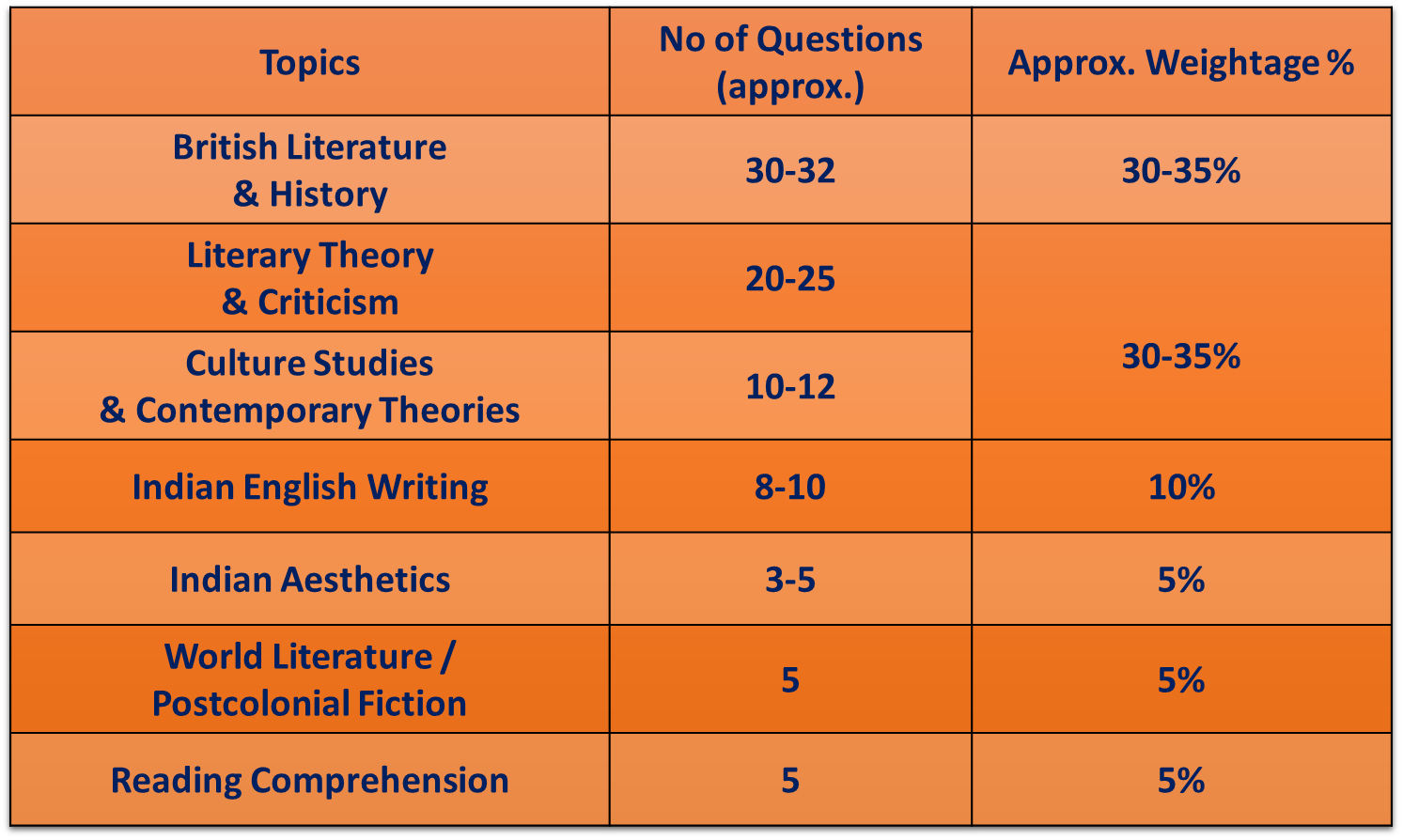
As is evident from the table below, a lot of weightage is now carried by contemporary studies and Indian Aesthetics, making these unconventional areas unavoidable. The paper pattern has moved beyond Rasa and Dhwani theory to venture into Alankar Shastra, Vakrokti, and Sphota — as in the question below. Solving the question requires detailed knowledge of Sanskrit Alankar shastra and Bhama’s seminal text Kavyalankar (6th BCE).
PYQ — Match List-I (Concept) with List-II (Meaning):
| List I (Concept) | List II (Meaning) |
|---|---|
| A. Aprastuta-Prasamsa | I. A statement conjunctively of the qualities and actions of things |
| B. Vyajastuti | II. Where a similar good or bad consequence is exhibited by connecting a thing with another object |
| C. Nidarsanam | III. Where the praise of an object with which one is not concerned is made |
| D. Sahokti | IV. Praise in the form of despair |
Similarly, only dedicated study of Vakrokti Alankar would yield accurate results in solving intense questions such as the one given below:
PYQ — Arrange the following levels of obliquity (Vakrata) as conceived by Kuntaka in Vakrokti Jivitam:
- Episodic
- Compositional
- Phonetic
- Lexical
- Grammatical
Indian English Literature
Postcolonial and modern Indian Literature in English is a high-scoring topic as questions are often based on authors almost all of us study in our UG and PG syllabus — Mulk Raj Anand, R. K. Narayan, Girish Karnad, Anita Desai, Jhumpa Lahiri, Amitav Ghosh, etc. So the following question is of basic level:
PYQ — Girish Karnad’s Hayavadana and Thomas Mann’s short novel The Transposed Heads is based on the tale of:
- Hitopdesha
- Panchtantra
- Jataka Katha
- Katha-sarit-sagara
While this one on Nirad C. Chaudhuri requires a little critical comprehension to solve:
PYQ — Which of the following books has an account of the ‘Adventures of a Brown Man in Search of Civilization’?
- A Passage to England
- A Passage to India
- Timeless India
- Defence of India
The trinity of modern English fiction — Raja Rao, Mulk Raj Anand and R. K. Narayan — remain non-negotiable and their whole oeuvre is to be diligently studied. It would come in handy while answering questions such as the one below, which requires thorough knowledge of an author’s body of work and major characters:
PYQ — Match R. K. Narayan’s novels with their themes:
| List I (Theme) | List II (Novel) |
|---|---|
| A. Disappointed lover becomes a Sadhu for a change | I. The Guide |
| B. Discharged convict is taken for a Sadhu | II. Waiting for the Mahatma |
| C. True historical Mahatma | III. Mr. Sampath |
| D. A scenario-writer imaginatively passes in review the possible history of Malgudi | IV. Bachelor of Arts |
Similarly, this question on Anita Desai can be solved easily if we are aware of major protagonists throughout her body of work’s life. Her novels like Clear Light of the Day, Cry the Peacock, Fire on the Mountain are must-read fiction works.
PYQ — Match authors with their ethnic/religious backgrounds:
| List I (Author) | List II (Background) |
|---|---|
| A. A. K. Ramanujan | I. Zoroastrian |
| B. Sharat Chandra | II. Jew |
| C. Jimmy Avissa | III. Hindu Srivaishnava |
| D. Nissim Ezekiel | IV. Lingayat |
Now, a question such as the one above is a surprise element — asking the ethnic backgrounds of authors is a new dimension in the UGC NET pattern. Nevertheless, it is scoring if attention is paid to the biography of the authors. The secret is in the smaller details which we often miss.
PYQ — Which of the following is NOT one of the conceptions of Dalit aesthetics given by Sharankumar Limbale?
- Human beings are first and foremost human — this is satyam.
- The liberation of human beings is shivam.
- The humanity of human beings is sundaram.
- The equality, liberty, justice and fraternity of human beings are satyam and sundaram.
We all are aware that lately there has been great emphasis on Dalit Literature and Dalit aesthetics. Voices of the intergenerationally marginalised have been gaining credence within academia, and that includes female marginalised voices as well such as Urmila Pawar, Baby Kamble, Daya Pawar, Sharmila Rege etc. Other important Dalit writers include Omprakash Valmiki, Namdeo Dhasal, Narendra Jadhav, etc.
Linguistics and Aspects of Language
Phonology in RP English, rules of articulation, definition and scope of Phonetics, organs of speech etc. are foundational to the study of linguistics and aspects of English Language. Let us analyse the question inclinations in this area.
The question below tests basic understanding of the definition of components of Linguistic studies. Such questions are highly scoring, and with a little revision we can successfully attempt them as they have been part of our UG/PG syllabus:
PYQ — Match List-I (Component) with List-II (Area of Language):
| List I (Component) | List II (Area of Language) |
|---|---|
| A. Phonology | I. Word system of languages |
| B. Morphology | II. Sentence-structure of languages |
| C. Syntax | III. Meaning |
| D. Semantics | IV. Sound systems of languages |
The following question is based on comprehension of Language Varieties i.e. Registers, Dialects, Idiolects, Sociolects, Pidgins, Creoles, Diglossia, Lingua Franca etc.:
PYQ — Which of the following definitions of social variation in language is incorrect?
- Convergence is a speech style that attempts to reduce social distance, and use forms that are similar to those used by the person we are talking to.
- A register is a conventional way of using language that is appropriate in a specific context, which may be identified as situational, occupational or topical.
- Slang describes words or phrases that are used instead of more everyday terms among younger speakers and other groups with special interests.
- Jargons are words and phrases, often involving body parts, bodily functions and sexual acts, that people avoid for reasons related to religion, politeness and prohibited behaviour.
The question below is on types of Morpheme. Be sure to study Bound Morphemes, Free, Derivational, Functional, and Inflectional Morphemes etc.:
PYQ — Which of the following is an example of a Functional Morpheme?
- Teach
- And
- -er
- -ed
The following question is on the Articulatory Function of consonants in RP English. Likewise, the articulatory pattern of vowel sounds should also be looked up:
PYQ — Arrange the following Manners of Articulation of the consonants of English in chronological order:
- Close Approximation
- Intermittent closure
- Complete closure and sudden release
- Complete closure and slow release
- Open Approximation
There were 3 more questions from Allophones, Organs of Speech, and Phonetics — giving the topic an overall weightage of 7–8 questions.
So, this was a brief analysis of the exam pattern, aimed at identifying the most heavily tested areas so that aspirants can prioritise their preparation more effectively. In the next blog, we will discuss practical strategies for studying in a focused and efficient manner, along with useful sources to cover even the less familiar or unconventional parts of the syllabus. Until then, happy learning and see you in the next post.